Taj Mahal or "the Taj" is a white marble mausoleum located in Agra, Uttar Pradesh, India. It was built byMughal emperor Shah Jahan in memory of his third wife, Mumtaz Mahal. The Taj Mahal is widely recognized as "the jewel of Muslim art in India and one of the universally admired masterpieces of the world's heritage"

Taj Mahal is regarded by many as the finest example of Mughal architecture, a style that combines elements from Persian andIndian architectural styles.
In 1983, the Taj Mahal became a UNESCO World Heritage Site. While the white domed marble mausoleum is the most familiar component of the Taj Mahal, it is actually an integrated complex of structures. The construction began around 1632 and was completed around 1653, employing thousands of artisans and craftsmen. The construction of the Taj Mahal was entrusted to a board of architects under imperial supervision, including Abd ul-Karim Ma'mur Khan, Makramat Khan, and Ustad Ahmad Lahauri. Lahauri is generally considered to be the principal designer.
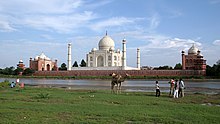
WHY IT WAS BUILT???
In 1631, Shah Jahan, emperor during the Mughal empire's period of greatest prosperity, was grief-stricken when his third wife, Mumtaz Mahal, died during the birth of their 14th child, Gauhara Begum. Construction of the Taj Mahal began in 1632.The court chronicles of Shah Jahan's grief illustrate the love story traditionally held as an inspiration for Taj Mahal. The principal mausoleum was completed in 1648 and the surrounding buildings and garden were finished five years later.
ABOUT IT'S TOMB
The tomb is the central focus of the entire complex of the Taj Mahal. This large, white marble structure stands on a square plinth and consists of a symmetrical building with an iwan (an arch-shaped doorway) topped by a large dome and finial. Like most Mughal tombs, the basic elements are Persian in origin.
The base structure is essentially a large, multi-chambered cube with chamfered corners, forming an unequal octagon that is approximately 55 metres (180 ft) on each of the four long sides. On each of these sides, a huge pishtaq, or vaulted archway, frames the iwan with two similarly shaped, arched balconies stacked on either side. This motif of stacked pishtaqs is replicated on the chamfered corner areas, making the design completely symmetrical on all sides of the building. Four minarets frame the tomb, one at each corner of the plinth facing the chamfered corners. The main chamber houses the false sarcophagi of Mumtaz Mahal and Shah Jahan; the actual graves are at a lower level.
The marble dome that surmounts the tomb is the most spectacular feature. Its height of around 35 metres (115 ft) is about the same as the length of the base, and is accentuated as it sits on a cylindrical "drum" which is roughly 7 metres (23 ft) high. Because of its shape, the dome is often called an onion dome or amrud (guava dome). The top is decorated with a lotus design, which also serves to accentuate its height. The shape of the dome is emphasised by four smaller domed chattris (kiosks) placed at its corners, which replicate the onion shape of the main dome. Their columned bases open through the roof of the tomb and provide light to the interior. Tall decorative spires (guldastas) extend from edges of base walls, and provide visual emphasis to the height of the dome. The lotus motif is repeated on both the chattris and guldastas. The dome and chattris are topped by a gilded finial, which mixes traditional Persian and Hindustani decorative elements.


The main finial was originally made of gold but was replaced by a copy made of gilded bronze in the early 19th century. This feature provides a clear example of integration of traditional Persian and Hindu decorative elements. The finial is topped by a moon, a typical Islamic motif whose horns point heavenward. Because of its placement on the main spire, the horns of the moon and the finial point combine to create a trident shape, reminiscent of traditional Hindu symbols of Shiva.
The minarets, which are each more than 40 metres (130 ft) tall, display the designer's penchant for symmetry. They were designed as working minarets — a traditional element of mosques, used by the muezzin to call the Islamic faithful to prayer. Each minaret is effectively divided into three equal parts by two working balconies that ring the tower. At the top of the tower is a final balcony surmounted by a chattri that mirrors the design of those on the tomb. The chattris all share the same decorative elements of a lotus design topped by a gilded finial. The minarets were constructed slightly outside of the plinth so that, in the event of collapse, (a typical occurrence with many tall constructions of the period) the material from the towers would tend to fall away from the tomb.
EXTERIOR DECORATION
The exterior decorations of the Taj Mahal are among the finest in Mughal architecture. As the surface area changes the decorations are refined proportionally. The decorative elements were created by applying paint, stucco, stone inlays, or carvings. In line with the Islamic prohibition against the use of anthropomorphic forms, the decorative elements can be grouped into either calligraphy, abstract forms or vegetative motifs.
THREATS
Many people think it is one of the most beautiful buildings ever built. However, it is slowly being damaged by acid rain. A nearby oil refinery has been blamed for some of the damage. In 1996, the Indian Supreme Court said that local industry was harming the Taj Mahal. The court set up an area of 10,400 square kilometers around the Taj Mahal called the Taj Trapezium Zone. Industries within this zone must use natural gas instead of coal.
There have also been concerns about the effect of visitors on the site. Rajan Kishore, a conservationist from Agra, has said that visitors walking through are putting too much pressure on the Taj Mahal, and suggested that the number of people allowed in be limited.
